
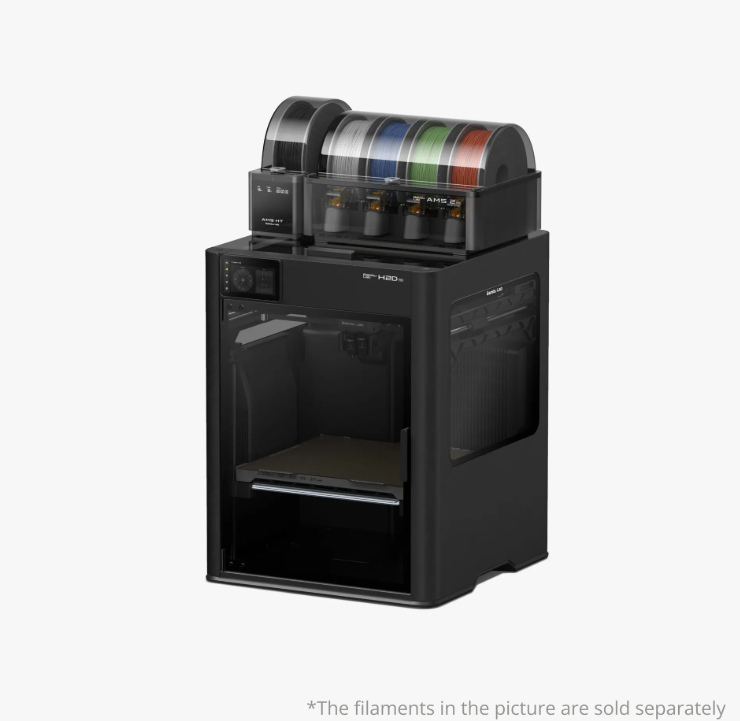
The H2 family—H2‑D Pro, H2‑C, H2‑D, and H2‑S—brings together higher performance motion systems, smart extrusion, and flexible material support in one platform. This post walks through what actually matters for everyday users: stability, uptime, and print capability, rather than just spec sheets.
The H2 family at a glance
The different H2 variants target slightly different users while sharing a common architecture. H2‑D Pro and H2‑C are tuned for more demanding materials and long production runs, while H2‑D and H2‑S focus on general‑purpose performance and ease of use. Across the range, the hardware is designed to handle larger build volumes and multicolor or multi‑material workflows efficiently, so stepping up to an H2 does not mean immediately hitting the limits of a small hobby machine.
DynaSense: smarter, more stable extrusion
At the heart of the H2 series is the DynaSense extruder, a key upgrade over basic drive systems. By tightly monitoring and controlling filament movement, DynaSense delivers more stable extrusion, which translates into smoother walls, sharper corners, and fewer random under‑extruded spots. Just as important, it adds intelligent clog detection, so the machine can recognize abnormal resistance in the filament path and pause a job before an entire long print is ruined. That combination of stability and protection is especially valuable on printers expected to run unattended or in production schedules.
Quick‑release hotend for real‑world maintenance
No 3D printer is maintenance‑free, so the way a machine handles maintenance matters. The H2 series includes a quick release hotend system, which lets users remove and swap a complete hotend module without digging through screws and fragile wiring. In practice, this makes it much easier to:
-
Clear a stubborn clog by swapping in a fresh hotend and servicing the old one later.
-
Change nozzle sizes for different jobs without tearing down the entire toolhead.
For schools, labs, and print farms, the ability to treat hotends as quick‑swap modules can significantly reduce downtime when a nozzle eventually wears out or a filament mishap occurs.
Material range and carbon‑fiber readiness
The H2 platform is built with a wide material range in mind, not just basic PLA. Across the series, the design supports common engineering filaments and carbon‑fiber‑reinforced materials, as long as users pair the printer with appropriate hardened or high‑temperature nozzles specified for their exact model. That means it can cover everything from classroom PLA prints to functional jigs, fixtures, and brackets that benefit from the stiffness and heat resistance of fiber‑filled polymers. For users planning to grow into more demanding applications, having that headroom built in is a major advantage.
Dual‑nozzle efficiency in the H2‑D
Within the lineup, the H2D stands out with an efficient dual nozzle mechanism. Rather than swapping filaments through a single nozzle every time a color or material change is needed, the printer can shift between two prepared nozzles. This reduces purge waste, shortens color‑change downtime, and helps maintain cleaner material interfaces. For multicolor logos, functional parts with soluble supports, or prints that combine a rigid structural core with a flexible outer layer, the dual‑nozzle approach offers both speed and reliability benefits.
Bigger builds and multicolor workflows
Finally, the H2 series pairs its extrusion and hotend features with larger build volumes and multicolor printing capabilities. A bigger build area means more options: batch printing many small parts at once, or producing single large components that would not fit on compact hobby printers. When combined with multicolor or multi‑material support, that space can be used for complex assemblies, teaching aids, and visually rich models that print as a single job instead of being glued together later.
For users stepping up from smaller machines, the H2‑D Pro, H2‑C, H2‑D, and H2‑S offer a clear path forward: smarter extrusion with DynaSense, easier maintenance through quick‑release hotends, support for advanced materials such as carbon fiber, and configurations like the H2‑D’s dual‑nozzle system that make serious multicolor printing practical instead of painful.


